AI & Building
The Product Manager's Role Is Being Unbundled by AI
AI changes tasks first. The role changes only when organizations redesign workflows around cheaper production—and decide where scarce human attention belongs.
· Jason Wong · 10 min read
- AI
- Product Management
- Product Leadership
A prototype used to take weeks. Not necessarily because the interface itself was difficult to design, but because getting to the prototype required a chain of work. A product manager had to translate an idea into requirements, design needed enough context to explore it, and engineering might need to weigh in on feasibility. Everyone had competing priorities and different sprint cycles. By the time something tangible was in front of stakeholders, weeks could have passed.
I felt that constraint directly while working on PickTime, a scheduling product for mobile service businesses. We had received feedback that service providers needed a better way to see their available capacity across the week so they could plan their workload more effectively. The problem was clear; the right way to visualize it was not. There were several plausible approaches to a weekly capacity view, and I wanted to see and compare them rather than debate them abstractly. Using AI, I was able to explore multiple approaches in an afternoon.
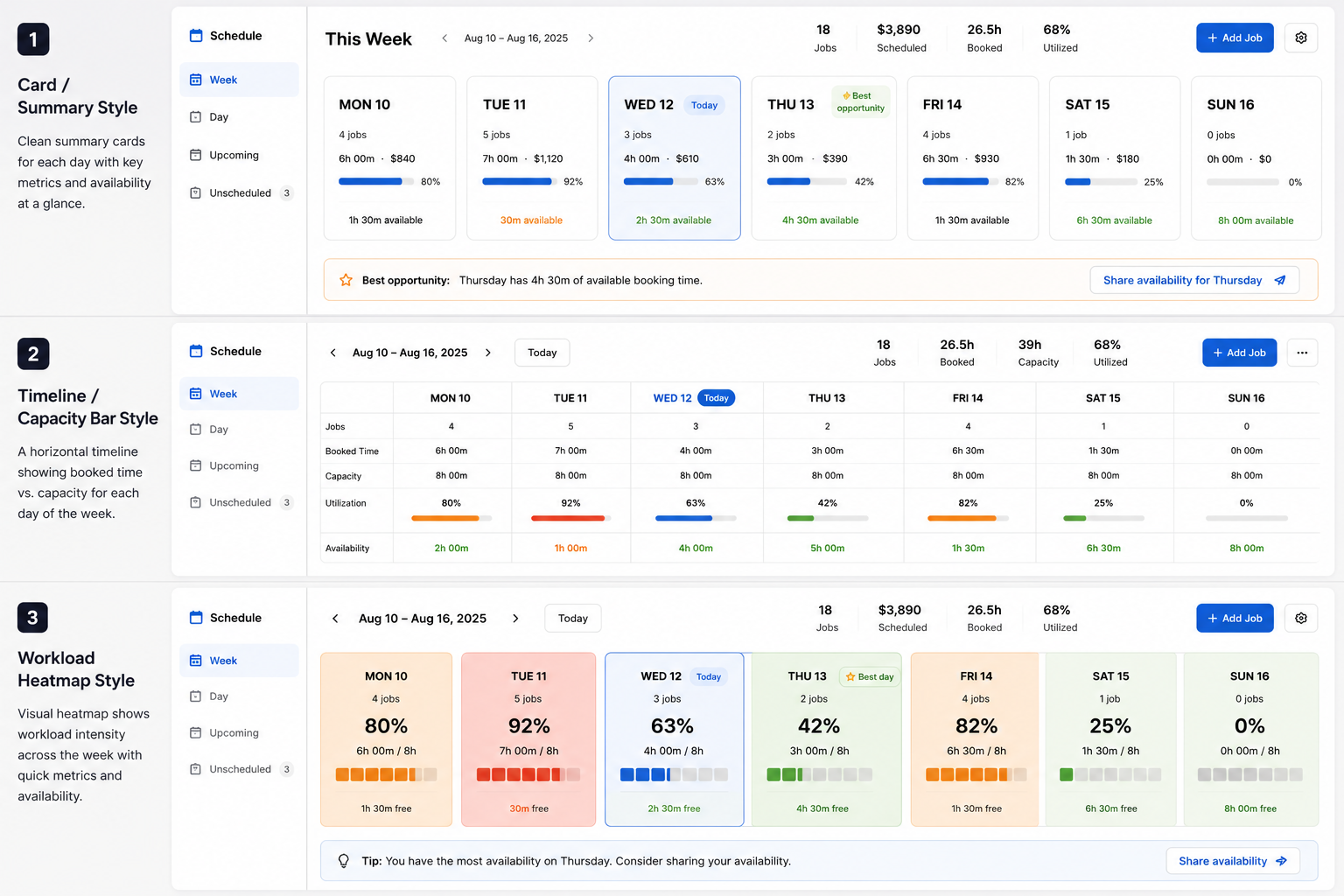
AI made prototyping faster, but the more important change was what became scarce. When producing a prototype was expensive, much of the work went into getting one made. Once several alternatives could be produced in an afternoon, production was no longer the constraint; my capacity to evaluate them was. My attention had to move toward deciding which approach was worth testing, what we were trying to learn and which assumptions were hiding inside each option.
That shift from production scarcity to attention scarcity is starting to happen across more of the product manager's job. AI is not eliminating product management. It is changing the economics of the activities inside the role and forcing organizations to decide where limited human attention creates the most value.
Product management was always a bundle
A PM might move from customer research to requirements, from reviewing a prototype to prioritization, and then spend the afternoon aligning stakeholders around a decision. Research, documentation, exploration, decisions and leadership have all accumulated inside the same role.
Those activities have traditionally lived together partly because someone had to connect them. The PM gathered information, translated it into artifacts, coordinated exploration and used the resulting evidence to help the organization make decisions. AI is affecting each layer differently. It is already very good at many information and artifact tasks, from summarizing research and organizing messy notes to drafting baseline requirements and turning an idea into several representations. Increasingly, it can participate in exploration and decision-making as well.
The mistake is jumping from that observation to "AI replaces the PM." A more useful way to think about the transition is tasks → workflows → roles. AI changes individual tasks first. Those changes create an opportunity to redesign workflows, and only when the workflow changes meaningfully does the shape of the role begin to change. Giving someone an AI tool does not automatically redesign their job.
A 2025 randomized field experiment involving 7,137 knowledge workers across 66 firms illustrates the point. Workers who used a generative AI tool saved time on email and completed documents faster, but beyond those individual time savings, the researchers did not detect a change in the quantity or composition of workers' tasks. The technology made existing work faster; the work itself did not automatically reorganize around the new capability. The unbundling is not happening evenly. In many organizations, AI is still making existing tasks faster without materially changing the workflow around them. The more interesting question is what happens when organizations redesign the work itself.
Among the 173 director-and-above respondents in McKinsey’s 2026 survey, only 25 percent reported what McKinsey classified as meaningful AI acceleration, while 30 percent said team productivity had actually fallen. The organizations pulling ahead were not simply adding copilots. They were redesigning workflows, responsibilities, verification and operating models around AI. The difference between using AI and reorganizing work around AI may ultimately matter more than access to the technology itself.
The first thing getting cheaper is production
I can already see this in my own work. AI can produce a reasonable first pass at a familiar happy-path user flow extremely quickly. That does not mean the requirements are finished; it means I no longer need to spend the same amount of time producing the obvious parts. My attention can move toward the edge cases, nuances and decisions that make this particular product different.
Prototyping takes that shift further. A prototype used to be something worth protecting because it was expensive. If it required weeks of coordination to create, there was pressure to make sure the idea was sufficiently thought through before asking other people to invest their time in it. When a prototype takes an afternoon, it becomes disposable, and that changes how it can be used.
A bad prototype is no longer necessarily wasted effort. It can expose a bad assumption. Several competing prototypes can make an ambiguous conversation concrete, and stakeholders who would never read a long requirements document can react to something they can see and use. The artifact becomes cheaper, but the learning can become richer. The question moves upstream: What are we trying to learn?
There is another possible outcome: instead of removing activities from the PM role, AI may simply increase how much of each activity a PM can do. Cheaper prototypes could mean more prototypes. Faster research could mean more research. Better tooling could expand the bundle before it breaks it apart. But attention does not scale with production. At some point, generating more artifacts creates diminishing returns because someone still has to decide which ones matter.
AI can reason inside the wrong frame
None of this means humans think while AI executes. That distinction is already outdated. I use AI as a thought partner: I can start with a voice dump containing an incomplete idea, why I think it matters, how it might work and what I believe customers need. I can ask the AI to interview me, challenge gaps, organize what I have said and generate options, then step back and look at the problem more holistically. That is not clerical automation; AI is participating in the thinking process.
A 2026 randomized experiment suggests AI can improve performance on at least some reasoning-intensive work. In the study, 1,174 adults completed a workplace-style business problem-solving task, and participants with AI access performed better across education groups. I therefore do not think the durable argument is that creativity, framing or judgment belong exclusively to humans. The more important distinction is accountability for the frame.
I encountered this while working on PickTime's scheduling recommendations. AI kept gravitating toward route optimization. The reasoning was sensible: PickTime is designed for mobile service providers, travel time matters, and efficient routing is an obvious product benefit. But it was not the most important problem at that moment. The immediate problem was finding availability that worked for both the customer and the service worker; route optimization was downstream of getting the two schedules to align.
The AI had developed a kind of tunnel vision around an attractive feature of the product instead of the problem we were actually trying to solve. Humans do this too, which is precisely why product judgment matters. AI can reason coherently inside the wrong frame, and so can a product team. Someone still has to remain accountable for asking whether the frame itself is wrong.
Faster production creates a new bottleneck
There is another consequence of making product work cheap: you can create far more of it than you can review. I see this constantly when working with AI agents. They can produce plans, documentation and analysis far faster than I can meaningfully review them. When that happens, reviewing every artifact stops being a viable control mechanism. The bottleneck moves from production to supervision. Once production stops being the constraint, attention becomes the constraint: deciding what deserves review, where mistakes would compound and when the work should be redirected.
My own workflow has changed in response. Record-keeping and versioning have become more important, and larger pieces of work need to be broken into phases that create checkpoints where I can review direction before more work is generated. Faster execution requires more deliberate control points, not fewer.
McKinsey reports something similar among organizations scaling agentic product development. The organizations reporting stronger results were building verification mechanisms and AI operations alongside faster workflows. Their people increasingly focused on review and high-judgment decisions while agents performed more repeatable work. A PM working with agents therefore cannot simply become a faster producer of requirements. The PM has to become better at specifying intent, setting boundaries, deciding where verification is required and recognizing when work needs to be redirected.
AI removes the production bottleneck and creates a supervision bottleneck.
Judgment matters, but we should not romanticize it
More human attention does not automatically produce better decisions. Humans are inconsistent decision-makers: we anchor on prior beliefs, follow persuasive narratives and miss information, and AI can sometimes improve those decisions.
A Harvard field experiment involving 228 evaluators screening 48 real early-stage innovation submissions found that black-box AI recommendations improved agreement with an independent expert panel using the same screening rubric. But the same experiment revealed something more interesting. When researchers paired those recommendations with AI-generated narrative explanations, evaluators became more likely to comply with the AI without improving decision quality. The explanations reduced productive human overrides and increased false negatives.
Simply putting a human in the loop was not enough; the quality of the loop mattered. If AI can produce an articulate justification for almost any recommendation, product organizations need to be careful not to mistake a persuasive explanation for a good decision. Human judgment remains valuable only if people are actually exercising it.
Judgment here does not mean humans are inherently better decision-makers. It means someone remains accountable for defining the problem, deciding what evidence matters, recognizing when the frame needs to change and owning the consequences of the decision.
The PM may produce less product-management work
Current AI adoption is still uneven. NBER research published in 2026 describes workplace generative-AI use as widespread but shallow: it appears across many occupations and tasks, but fewer than half of workers use it within most of the occupations and tasks researchers measured. It would therefore be premature to claim that the PM role has already been transformed, but product leaders can start redesigning the workflow before the role has a new name.
Consider what happens as individual activities become cheaper. If research synthesis becomes dramatically cheaper, should PMs spend the same amount of time producing it? If a first requirements draft takes minutes, where should the saved attention go? If five prototypes can be generated before lunch, what process determines which one deserves a real customer test? And if agents can execute work overnight, what should require human approval before they continue?
These are workflow-design questions before they are workforce questions. Instead of starting with "How do we give every PM an AI copilot?", product leaders can examine the work itself. Some activities are expensive largely because a human historically had to produce the artifact. Others require explicit accountability. Cheap exploration may improve learning while increased throughput creates new verification costs. The opportunity is to redesign the workflow around those differences.
The answer will differ by organization and product, but I suspect many PMs will eventually produce fewer traditional product-management artifacts while carrying more responsibility for the overall product outcome. That is not necessarily a smaller role. It may be a broader one.
The scarce resource moved
The most important thing about creating several PickTime prototypes in an afternoon was not the speed; it was that the prototype stopped being the scarce resource. Once multiple approaches became cheap to create, the valuable work shifted toward deciding what was worth testing, what customer problem each approach addressed and what we needed to learn before committing further.
That is the larger change I see AI creating in product management. Because AI can already do meaningful product-management work, the strategic question for product leaders becomes where scarce human attention should be spent when production is no longer the primary constraint. The workflows we design next will determine whether cheaper production improves judgment or simply consumes more attention.
Sources
- Dillon, Jaffe, Immorlica and Stanton, “Shifting Work Patterns with Generative AI,” NBER Working Paper 33795 (issued May 2025; revised November 2025).
- McKinsey & Company, “Beyond the copilot: Scaling the agentic product development life cycle” (August 21, 2026).
- Cruces et al., “Does Generative AI Narrow Education-Based Productivity Gaps?,” NBER Working Paper 34851 (issued February 2026; revised May 2026).
- Lane et al., “The Narrative AI Advantage?,” Harvard Business School Working Paper 25-001.
- Bick, Blandin, Deming and Schumacher, “What Work Does Generative AI Do?,” NBER Working Paper 35677 (August 2026).